New Ways of Thinking
Designer and Citizen–A Nondual Relation
 In a world where runaway consumerism is leading to the real possibility of destruction of planet earth, User Experience (UX) designers and the design processes they follow contribute to the constant creation of new and desirable experiences and fear of obsolescence.
While there is new thinking by some sections of the international design community to create responsible/conscious design processes, a more radical shift is needed in current design practices. This article explores the concept of a non-dual relationship between designers and citizens and the creation of citizen designers, as a possible approach to more responsible and inclusive design practice.
Without problematizing the current duality between designers and citizens, the narrow sliver available to get an outsider’s view of the world of citizens is unlikely to shift even if an alternative UX framework was in place.
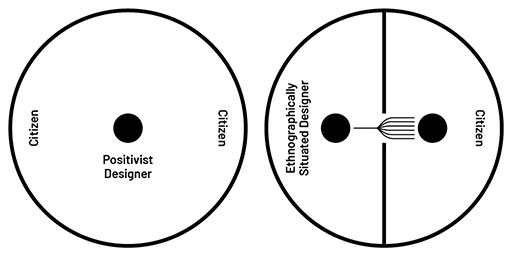
The current view is of two separate worlds – that of the designer as expert observer and the citizen as the quotidian observed. They inhabit different fields, to use Bourdieu’s construct (Bourdieu 1984, 1993) and hence understand the game of everyday living through different rules. The positivist designer like the post Socrates monistic philosophers who centred their cosmologies on the Monad or One, centres her design cosmology on the repeatable nature of phenomenon in the lives of citizens and the designer’s expertise to measure and interpret these phenomenon and design for the challenges these phenomenon may bring about for citizens’ ability to get their ‘job’ done (Figure 1).
The more recent avatar of the positivist designer is the ethnographically situated designer who draws inspiration from ethnography and recognises that each citizen may experience the same phenomenon in different ways and hence the need to step out of the experimental user experience research laboratory and step into the situated world of the citizen. This designer uses ethnographically inspired methods as a rake to gather insights from the citizens lived experience to conceptualise designs that mitigate challenges faced by citizens in the specific domain being researched and provide persuasive ways to make citizens engage with the design based on the peek into their lived experience (Figure 2).
Both designers view their role as that of experts and separated from the role of the citizen.
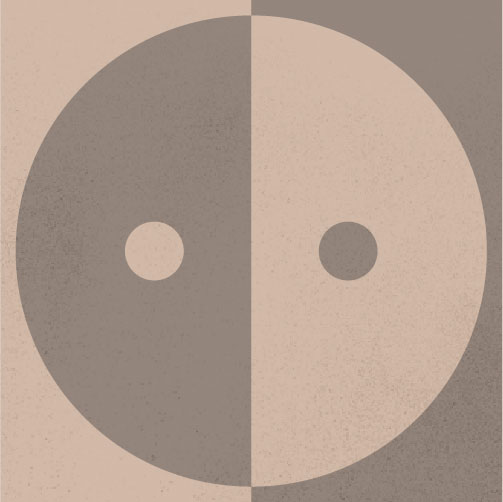
There needs to be a shift in the perspective of designers having to develop the skill to stay objective and neutral and maintain a clear separation between the multiple fields they inhabit (that of designer and citizen). Instead the non-dual perspective of the yin yang (Figure 3) provides inspiration of a construct to shift to. Non-duality is not the rejection of duality but the inclusion of all dualities. The Yin Yang symbolizes the concept of non-duality in the form of the whole made of two parts..It is one circle made of two opposite and complementary movements which are in themselves paradoxical since both contain their opposite at their hearts. These two forces both create and neutralize each other, and they’re held together within the completeness of the encompassing circle.
 How can designers and citizens be engaged in a yin-yang interaction that is a two-way process of constantly increasing awareness and understanding of each other’s field and being able to jointly contribute to the objectives of a specific design initiative as well as defining the outcomes? How, in fact, can we have everyone be a citizen designer? This seems impossible without the ability of the designer to reach out and connect with citizens across all walks of life and be able to continue to interact with and evolve these connections over time. The concept of bridging, bonding and linking is a concept of relevance to this question.
A non-dual relationship with citizens (and not users) will allow designers to continuously enrich their knowledge and wisdom about the context of citizens, a context that constitutes lived experiences, cultural and ethical values, matrix of needs and capabilities that are desired. A connection with citizens that is about mutual learning and agency, a connection that makes citizen designers of all. This then allows designers to do much more then solving business needs, much more than being problem solvers. This non-dual relationship allows designers to be the conscience keepers who raise questions about the purpose of the design, about its holistic impact on citizens and the world, the structural inequalities that the design is likely to reinforce. The designers then help find answers to the questions in ethical, innovative ways (given their deep understanding of the citizen’s context) that enable businesses to benefit, while always being in partnership with citizen designers.
