New Ways of Doing
Vignettes – Reclaiming the Ctizen from Consumer to Designer
 How can one involve citizens to be part of the design process, not just as research participants answering structured questions needed for a specific project but as collaborators at all times, to hear their opinions on topics related not just to a project, but to life itself?
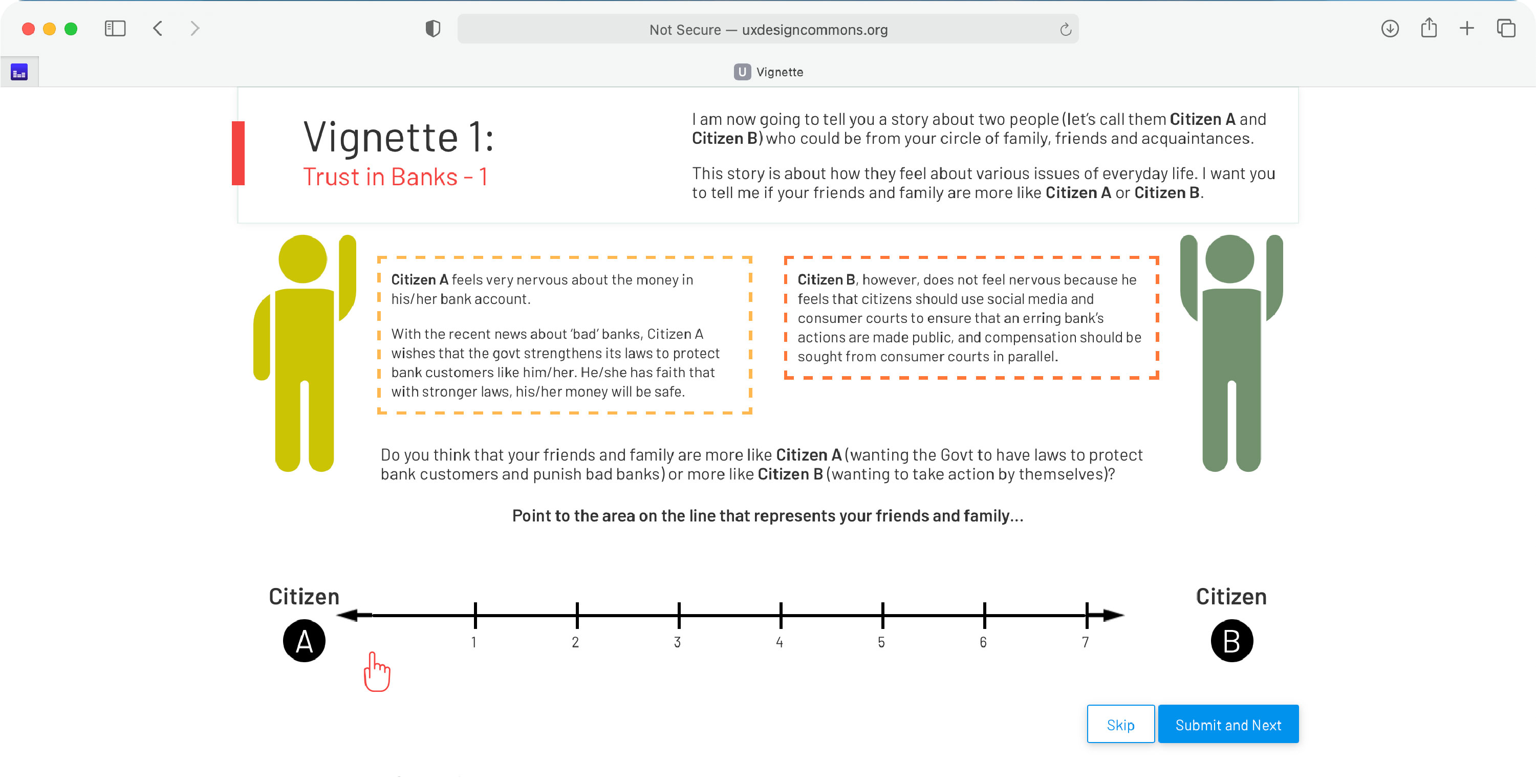
Vignettes are short stories about a hypothetical person, presented to participants during qualitative research or quantitative research, to glean information about their own set of beliefs. They are usually developed by drawing from previous research or examples of situations which reflect the local context, creating a story that participants can relate to. Participants are typically asked to comment on how they think the character in the story would feel or act in the given situation, or what they would do themselves. As the focus is on a third person, vignettes can be advantageous in research on sensitive topics where the participant may not feel comfortable discussing their personal situation and may conceal the truth about their own actions or beliefs. They can also, through normalisation of the situation, encourage participants to reveal personal experiences when they feel comfortable to do so (Hughes 1998; Renold 2002; Finch 1987; Barter and Renold 2000). Participatory group research is an effective method for developing vignettes.
Anchoring Vignettes
Anchoring vignettes are a structured elicitation tool commonly used in anthropological research, health behaviour studies, and public opinion polls (Hopkins and King 2010; Chevalier and Fielding 2011; Salomon et al. 2003; Kohrt 2018) As individuals may have a social desirability bias toward responding in the affirmative, anchoring vignettes can be used to normalize a range of responses (Nederhof 1985). Grol, Freese and Hauser (2011) have described the use of anchoring vignettes in a study where piloting preferences for health devices in the study revealed that some of the women respondents felt negatively about the devices. Hence the researchers created 2 vignettes to anchor the response options where one vignette would present one scenario and the other vignette would present the opposite scenario for the same criterion/situation. Respondents were then asked which vignette women in their community were more likely to identify with, thereby encouraging a range of responses.
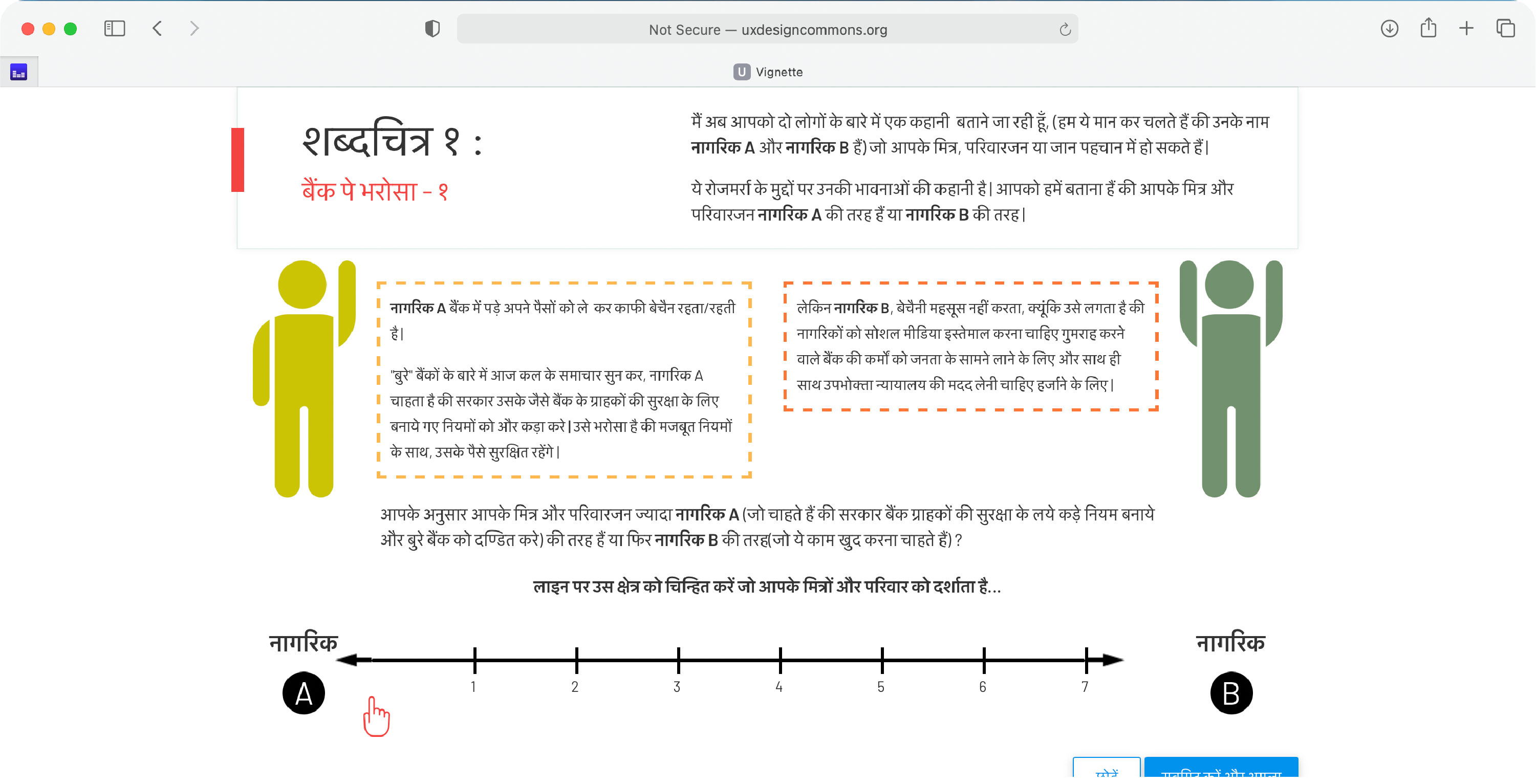
We present 10 vignettes that we have used. These were made available to our citizen designers by situating them on this site.
The user started out in the 1970s as a cog in a rational machine, become a source of error in the 1980s and then a social actor in the 1990s, and is now a consumer."
How were the Vignettes used?
Three emails were sent to all citizen designers (who participated in earlier research with us), explaining how the vignettes came about and what the objective was and seeking their suggestions. It was felt that it was important to share with the citizen designers and get their opinion about the topics presented via the vignettes and it was also a way to see if various contextual topics could become part of the conversations with citizen designers. They were also invited to rate the vignettes.
Please feel free to use these vignettes for your research. IF you do use these vignettes, we would really appreciate you sharing a summary of the research process and findings here, for everyone’s benefit.
Also, if you wish to know more about the insights we gained from the use of these vignettes, please click for English and Hindi version.